


Learn how to scale smarter and increase capacity with our free Agentic AI video training series. Watch now.
Every agentic system you deploy represents a statement about what you trust,
what you value, and where you believe accountability belongs. Those chasing
speed without structure become cautionary tales.
At Prowess, we believe responsible AI is the required foundation for transformational generative and agentic systems.
In turn, these systems enable velocity, scale expertise, and turn governance into a competitive advantage.
Our approach is grounded in:
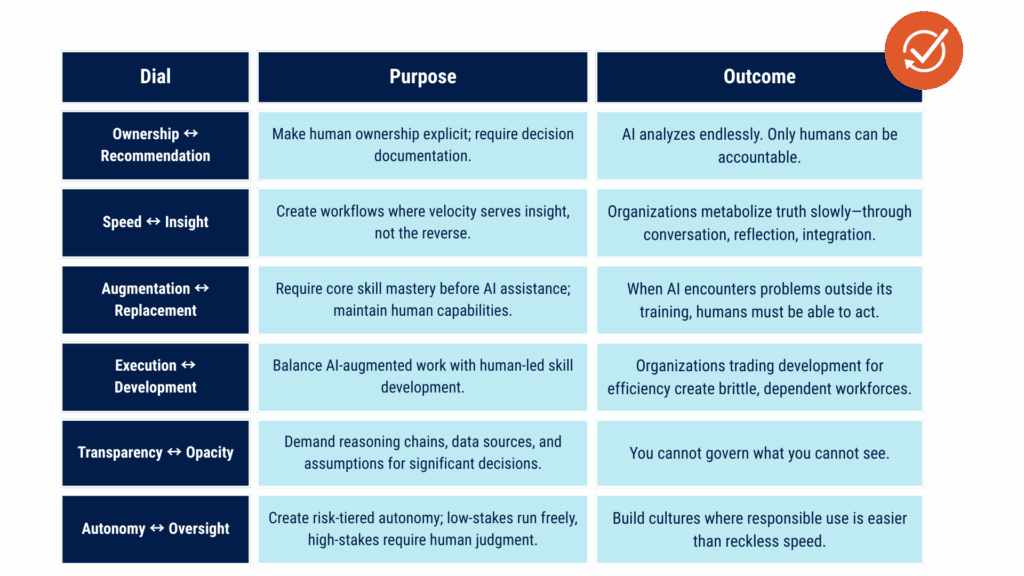
We’ve built our practice on a simple truth: the organizations that move fastest are those with the clearest controls. Seven principles, in combination with what we call our “Agentic Dials,” provide the framework for truly impactful and responsible deployments.
The principles that shape our approach to agentic Ai that set us apart.
AI executes. Humans decide. Organizations bear responsibility.
Intelligence is not one-size-fits-all all. Organizational and collective intelligence originates from human judgement and creativity. Our clients’ customers and employees rely on us to empower them with systems that keep humans at the center of AI.
In practice, this means:
Organizations create conditions for catastrophic failure when they overlook the centrality of human aspects by letting algorithms dictate strategy or automate processes without human accountability.
Speed without understanding creates the illusion of productivity while eroding institutional wisdom.
Our Velocity Serves Insight framework helps ensure that autonomous systems deliver exponential throughput while maintaining human-centric oversight for complex decisions, exceptions, and high-stakes actions. The approach builds the institutional trust that enterprise adoption requires.
In practice, this means:
AI systems inherit the biases in their training data. Responsible AI means actively rooting out unfairness.
Following Microsoft’s Responsible AI Standard and the NIST AI Risk Management Framework, we implement fairness as a continuous practice, not a one-time check.
In practice, this means:
You cannot govern what you cannot see.
Recent vulnerabilities—from Salesforce’s CVSS 9.4 prompt injection flaw to the OpenAI ChatGPT “ShadowLeak” vulnerability—prove that opacity creates risk. Transparency isn’t just ethical; it’s an operational necessity.
In practice, this means:
AI should perform consistently, not just on its best days.
Research shows that enterprises lose $67.4 billion annually to AI hallucinations, and top LLM-based agents fail over 70% of the time on basic business tasks. Responsible AI means building systems that are robust, testable, and resilient.
In practice, this means:
Personal information must be safeguarded, not exposed or misused.
With over 700 organizations compromised in recent breaches and 20% of breaches involving shadow AI, privacy and security can’t be afterthoughts.
In practice, this means:
Someone must take responsibility—whether AI gets something right or wrong.
The challenge with agentic AI is that these systems can perceive, reason, plan, and act with minimal human involvement. This autonomy introduces new risks: tool misuse, cascading action chains, and unintended control amplification.
In practice, this means:
These dials distinguish what you can control from what you cannot. They ensure your organization remains deliberately human-led while effectively leveraging autonomous systems.
Start with appropriately scoped pilots rather than broad "give everyone ChatGPT" strategies. Target specific pain points where agentic AI can deliver measurable value.

The best implementations augment human expertise rather than attempting full replacement. Start with tasks that naturally include human-in-the-loop decision points.

Choose tools that are out-of-the-box compatible with existing business systems. Play to AI's strengths as a highly integrable technology.

Invest in training, policy development, discussion, and performance tracking. Organizational culture is the fabric AI gets woven into, not an afterthought.

Start from comprehensive policies around data privacy, security, decision authority, and liability. Establish clear ownership, escalation paths, and auditability.

The winning organizations won’t be those with the fastest AI. They’ll be those with the clearest controls enabling strategic flexibility.
Organizations that establish clear guardrails can move faster precisely because they’ve defined where judgment lives, where humans remain essential, and where machines serve collective intelligence. This is how 52% of executives who have deployed AI agents are seeing positive ROI, with over half citing 6-10% revenue growth from agentic deployments.
Every agentic system you deploy represents a statement about what you trust, what you value, and where you believe accountability belongs. Those chasing speed without structure become cautionary tales.
At Prowess, we help you build systems that are intelligent, accountable, transparent, and aligned with human values. Because the future isn’t about replacing humans—it’s about augmenting them with dynamic systems that can learn and act on their own, while remaining governable.
Ready to deploy agentic AI responsibly?
Schedule a consultation: To learn more about how Prowess can help you adopt agentic AI with speed and strategic control, email brendon.shaw@prowessconsulting.com.
Industry Frameworks & Standards:
Recent Research:
Copyright © 2025 Prowess Consulting, LLC. All rights reserved.
Other trademarks are the property of their respective owners.
As founder and CEO of Prowess, Aaron Suzuki has led the organization to become a thriving business filling the important space between technology development and marketing teams with technology, applications, content, and analytics.
Aaron was also the founder and CEO of SmartDeploy, a Seattle-based IT management software company. SmartDeploy simplified the secure configuration and management of business computing endpoints for thousands of customers globally.
Earlier in his career, Aaron served as Director of Business Development at Entirenet, a Seattle-based technical services firm. Before moving to Seattle, Aaron was President of Inetz Media Group, a web application development company based in Salt Lake City.
Aaron holds a B.S. from Brigham Young University and a M.S. from the University of Iowa. An avid cyclist and passionate skier, he also serves on the Board of Directors of Blue Devils Performing Arts, a youth performing arts non-profit.