
AI-enabled outsourcing is transforming traditional outsourcing into a strategic driver of enterprise agility, efficiency, and profitability. By combining agentic AI with skilled suppliers, organizations can scale capacity, accelerate delivery, and achieve measurable ROI faster than conventional approaches. Frontier outsourcing—anchored in AI agents and supported by robust security, governance, and workforce strategies—turns suppliers into strategic partners while protecting institutional knowledge and maintaining human oversight. Organizations that embed these elements from the start unlock rapid productivity gains, strengthen operations, and create a foundation for sustainable, enterprise-wide transformation.
Read this framework to learn:
-
How AI-enabled outsourcing turns traditional labor models into scalable, agent-driven operations
-
How AI agents expand supplier capacity, speed delivery, and boost agility
-
Key practices for security, governance, and workforce planning to reduce risk
-
How to assess readiness and select frontier-ready suppliers
-
A roadmap for piloting, scaling, and improving AI-enabled outsourcing
-
Ways to measure value, mitigate risk, and drive long-term advantage
Who this framework is for:
-
COOs, procurement, and vendor leaders seeking higher ROI from outsourcing
-
Operations, finance, and compliance leaders managing repetitive or complex processes
-
Business and IT executives adopting AI safely and efficiently
-
Decision-makers in regulated industries balancing automation, security, and compliance
-
Supplier organizations aiming to become strategic, AI-powered partners
____________________________________________________________________________________________________________________
A Framework for AI-Enabled Outsourcing
A “frontier” approach to outsourcing, powered by agentic AI, is transforming outsourcing from a cost-cutting tactic to a catalyst for enterprise agility, capacity, and profitability. Supplier-led initiatives help reduce the risks of adopting agentic AI across the enterprise while proving ROI.
Executive Summary
Despite investing billions of dollars in AI, most enterprises have seen only marginal gains. That may be changing. Now, AI agents offer a different way to use AI to realize revolutionary advantages. The result can be a much more efficient, productive, nimble, and profitable business. However, this transformation requires a strategic commitment, a culture shift, retraining and reskilling, technical architecture, and new metrics.
The stark reality: Industry analysts predict 40% of agentic AI projects will be canceled by 2027.1 Not because the technology doesn’t work, but because organizations treated AI adoption as a technical problem. Actually, it’s a transformation requiring simultaneous attention to systems, data, governance, security, and people. Organizations that rush deployment without proper attention to these factors create breaches costing $670,000 or more per incident.² Those that automate jobs without workforce strategy lose critical institutional knowledge and employee loyalty that took years to build.
The opportunity: Organizations that take a disciplined, strategic approach to implementing AI agents —by carefully managing change, investing in workforce development, and ensuring robust governance—are seeing productivity gains while simultaneously strengthening institutional capabilities. In this context, outsourcing becomes more than a means to reduce costs or scale operations. It serves as a catalyst that accelerates and amplifies AI-driven transformation. By partnering with professional services firms experienced in agentic AI deployment, organizations can access specialized expertise, avoid common pitfalls, and maximize the value delivered by their AI investments. Such collaborations become a reliable predictor of successful transformation journeys.
AI agents don’t change the core objectives of outsourcing (risk and cost reduction, scalability, and time savings), but they do amplify them. By implementing agentic AI with proper security controls, governance frameworks, and workforce strategies, providers of outsourced services can embody best practices and deliver immediate new value. This approach can also spark a virtuous cycle of AI adoption across the teams they serve and beyond. We refer to this approach as “frontier outsourcing.”
This paper describes frontier outsourcing and how both purchasers of outsourced services (“purchasers”) and providers of outsourced services (“suppliers”) can apply agentic AI principles to change the business equation and achieve previously unimaginable value. It also explains how to avoid the catastrophic failures that have plagued early adopters who moved too fast.
Key Success Factors:
- Security & governance: Executive sponsorship, clear accountability, comprehensive monitoring
- Data & process readiness: Quality baselines, evaluation infrastructure, continuous improvement
- Workforce strategy: Transparent communication, retraining investment, systematic role redesign
- Strategic partnership: Suppliers as risk mitigators and transformation partners, not just capacity providers
The Transformative Potential of AI Agents
Key Takeaways
- AI agents act as digital machines, working autonomously with human oversight.
- Traditional software is shifting to AI-driven workflows with entirely new capabilities.
- Agentic AI is a source of scalable, cost-effective productivity transforming business.
AI agents are like digital workers. They are small pieces of software powered by AI that can autonomously perform tasks under human oversight. When intelligently applied with proper controls, they can greatly improve the scalability, efficiency, and cost-effectiveness of business processes.
Businesses have spent decades integrating their operations with human-centered business applications. Enterprise resource planning (ERP), human resource management (HRM), and other enterprise software platforms evolved with the assumption that people are required to carry out portions of the work involved. This assumption places human-centric interaction at the center of all stages of data processing, from project resourcing strategy to inventory checks.
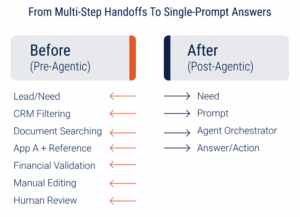
Legacy workstreams require the technical work for automation or include many manual steps. Agentic workstreams rely on AI to greatly simplify workflows increasing capacity and retaining human intelligence.
Agentic AI changes that assumption. By shifting away from the dependency on humans to complete certain tasks, agentic AI changes how information is processed and how it travels through an organization. With the safe, secure, and responsible introduction of agentic AI, humans retain responsibility, but most labor is shifted to AI agents.
This fundamental change means agentic AI is rapidly rewriting the rules of business, providing an inexpensive source of constantly growing intelligence that is available to everyone. Agentic AI doesn’t just address conventional business strategy concerns like pace and scale. It also adds new business process capabilities, inviting the reinvention of business operations at a foundational level. This cheap source of capability and depth gives organizations of all sizes extraordinary leverage, and it makes equally extraordinary promises about efficiency, insight, and profitability.
However, this promise comes with critical requirements. Organizations cannot delegate security and governance to vendors while retaining accountability for outcomes. When agents fail deleting databases, fabricating facts, leaking data—clients bear the consequences regardless of who built the system. Success requires treating agentic AI as organizational transformation, not an IT project.
With agentic AI presenting such promise, leaders now face the challenge of reformulating their businesses optimally around a combination of AI agents and human judgment and creativity to get the best results. Leading organizations are updating their AI strategies by using digital outsourcing with AI agents, supported and overseen by humans. AI leader Microsoft calls these businesses “Frontier Firms,”³ as they boldly undertake rapid learning and experimentation to decouple from the human-centered application design patterns of the past.
The Case for Frontier Outsourcing
Key Takeaways
- AI enhances outsourcing benefits—cost savings, risk reduction, and scalability—without replacing them.
- AI-powered suppliers extend human capabilities and boost productivity.
- Purchasers must embed AI in outsourcing to turn supplier partnerships into transformation drivers.
Frontier AI use in the enterprise naturally and necessarily extends to outsourcing. All purchasers, from executive leadership through to line managers, need to align outsourcing strategies with their AI strategies to maximize organizational benefits. To reduce costs and increase efficiency, enterprises often engage a large contingent workforce of suppliers. Doing so can help the business focus on its core strategy and remain flexible while growing. These traditional reasons for outsourcing remain the same in the new frontier formula for business, but the dynamics change because AI multiplies the value of outsourcing.
Frontier outsourcing adds a critical new dimension: risk mitigation. Suppliers who specialize in agentic AI bring expertise that most enterprises lack internally. Not just in building agents, but in securing them, governing them, and deploying them safely. They can serve as:
- Security specialists who implement cryptographically signed audit trails, prompt injection defenses, and automate circuit breakers from day one
- Governance partners who establish evaluation infrastructure, monitoring dashboards, and incident response procedures before agents touch production systems
- Transformation guides who help navigate the complex intersection of technology, data quality, process redesign, and workforce impact

AI-enabled outsourcing teams can provide breathtaking new value while reducing risk for an organization. With frontier outsourcing, a supplier’s teams of subject-matter experts (SMEs) can manage AI agents to dramatically expand the teams’ capabilities and boost productivity as agents complete tasks with greater efficiency. More importantly, suppliers who have already navigated the security, governance, and workforce challenges become living models for internal teams—demonstrating what works, what fails, and how to avoid the expensive mistakes that lead to project cancellation.
Traditional outsourcing focuses on capacity and cost. Frontier outsourcing adds capability, expertise, and risk management to that equation—transforming suppliers from labor providers into strategic partners in enterprise AI transformation.
The Role of AI Agents in Outsourcing
Key Takeaways
- AI agents expand supplier capacity without raising headcount or costs.
- Purchasers gain agility as suppliers take on more operational work through AI efficiency.
- Businesses that don’t embed AI into outsourcing risk falling behind.
AI agents will dramatically expand the capacity of supplier delivery teams. Work that lends itself well to outsourcing often entails high-scale enterprise workflows and business processes, which is the very work that stands to gain the most from AI assistance. AI agents can accelerate the delivery of outcomes aligned with business objectives, multiply outsourcing scale without growing headcount, and reduce outsourcing costs. Frontier firms, purchasers and suppliers alike recognize that AI assistance is now a necessity across all work streams in order to stay competitive, or that it will quickly become one.
Purchaser and supplier teams that implement agentic AI effectively can achieve multiple important benefits, including:
- Agility
Supplier teams can take on larger volumes of work with a broader scope, yet remain relatively small and focused compared to teams without the support of AI agents. This enables purchasers’ businesses to respond immediately to changes in direction and emerging priorities. - Strategic focus
The management, administration, and contracts that can bog down purchaser leaders and managers are driven into fewer, smaller teams, which alleviates the burden. Purchaser leaders can, therefore, stay focused on strategy and moving the business ahead. - Competitiveness
A lighter-weight and streamlined cohort of suppliers can give a purchaser’s business an advantage compared to slower-moving competitors who are still mired in the effort of scaling supplier management and other procurement challenges. - Cost control
Frontier suppliers who implement proper security controls, governance frameworks, and monitoring capabilities actively reduce enterprise risk rather than introducing it—a fundamental shift in the value equation of outsourcing. - Profitability
All of the added efficiencies, agility, focus, cost control, and risk reduction drive bottom-line improvements.
To maximize these gains, purchasers should set clear expectations around the presence and pace of AI-based solutions throughout their work, along with non-negotiable security and governance requirements. Supplier teams that adhere to agentic AI strategies with proper controls will see steady improvement and a shift in thinking and culture.
At maturity, purchaser and supplier teams will rely on an array of evolving AI agents that amount to low-cost labor doing most of the busy work. People act as AI agent managers, ensuring the work is complete and accurate. And the gains will go even farther, with the potential emergence of entirely new business strategies in a fully-realized agentic AI work environment.
Supplier team evolution must accompany—or even lead—purchaser stakeholders via the supplier’s discovery, experimentation, and achievements using AI agents. The best suppliers will initiate conversations, help provide vision, and chase answers to difficult questions in order to help realize the vision of agentic AI. Both purchasers and suppliers should apply their experience and help create and improve AI agents and systems to increase agent productivity over time.
Security, Governance, and Workforce Strategy: The Non-Negotiables
Key Takeaways
- Strategic security, governance, and workforce alignment are non-negotiable foundations for agentic AI success.
- Most AI failures stem from weak oversight, unclear accountability, and poor data readiness rather than flawed technology.
- Organizations that embed controls, evaluation, and workforce training from day one achieve durable productivity gains and institutional strength.
The difference between the 40% of projects that will be canceled and those that deliver transformational value comes down to three foundational elements that must be addressed simultaneously: security, governance, and workforce strategy. Organizations that treat these as afterthoughts join the failure statistics. Those that embed them from the start achieve productivity gains of 45-70% while building institutional strength.
Security: Build Protection From Day One
The reality: 97% of organizations experiencing AI breaches lacked proper access controls. Shadow AI accounts for 20% of data breaches and costs $670,000 more per incident on average. Recent high-profile incidents, from deleted production databases to $440,000 reports filled with fabricated research, demonstrate that security failures have catastrophic consequences.²
Essential Security Controls:
- Unique non-human identities: Assign each agent a unique identity with least-privilege access and cryptographically signed audit trails showing exactly which agent did what, when, and why.
- Red team testing: Conduct adversarial security testing before deployment. Test for prompt injection, credential theft, privilege escalation, and API abuse scenarios.
- Circuit breakers and guardrails: Implement automated halt triggers for high-risk operations, cost ceilings, rate limits, and anomaly detection comparing actions to behavioral baselines.
- Shadow AI detection: Deploy network monitoring to detect unmanaged AI usage. Employees paste sensitive data into consumer AI tools an average of 14 times per day.4 You cannot secure what you cannot see.
- Continuous security assessment: Conduct quarterly penetration testing with rotating attack vectors. Static security equals declining security as threat landscapes evolve.
Supplier advantage: Frontier suppliers who implement these controls as standard practice reduce purchaser risk while accelerating deployment. Security becomes a competitive differentiator, not a checkbox.
Governance: Establish Clear Accountability & Oversight
The reality: Only about one-quarter of enterprises have fully implemented AI governance programs, leaving the majority (≈60–65%) either without formal policies or still developing them.5 Analysts consistently report that governance failures, not technology limitations, account for up to 40% of canceled AI projects.¹ Without clear decision rights, agents get stuck in political gridlock or deployed without adequate controls.
Critical Governance Elements:
- Executive sponsorship with kill-switch authority: Establish board-level oversight with a cross-functional governance committee (including security, legal, compliance, business, and HR). Ensure clear accountability for agent outcomes.
- Measurable success criteria: Never launch vague “efficiency” projects. Define specific targets—90% accuracy, <2 hour processing time, <1% audit error rate—so you know when to scale or shut down.
- Regulatory compliance mapping: Inventory all obligations (GDPR, HIPAA, EU AI Act) before deployment. Fixing compliance issues post-launch proves exponentially more costly than addressing them upfront.
- Data quality baselines: Establish completeness metrics, freshness standards, and accuracy validation before agents touch the data. The majority of RAG systems degrade soon thereafter due to poor data quality.
- Evaluation infrastructure first: Build continuous testing for accuracy, cost, hallucinations, and drift before deploying agents. Evaluation is the unit test for AI. No one deploys code without tests.
- Comprehensive monitoring: Create AI-specific dashboards tracking performance, cost per interaction, drift detection, escalation patterns, and hallucination rates with automated alerting.
Supplier advantage: Suppliers who arrive with established governance frameworks, evaluation infrastructure, and monitoring capabilities dramatically reduce time-to-value while ensuring purchaser compliance obligations are met.
Workforce Strategy: Treat People as Stakeholders, Not Resources
The reality: How you manage workforce transition determines whether you build institutional strength or organizational resentment. Organizations that eliminate roles without a transition strategy lose critical institutional knowledge. The employees and suppliers who understand customers, processes, and edge cases help improve agents that will otherwise fail for years. Those who invest in systematic transition see people become agent champions who train systems and identify improvements.
Essential Workforce Elements:
- Honest impact assessment: Identify which roles face high automation exposure and develop three-track plans for retraining for new roles, hybrid role redesign, or dignified exit with generous support.
- Transparent communication: Leadership delivers clear messaging about changes, timeline, investment in retraining, and commitment to treating people with dignity. Vague announcements create panic.
- Retraining with employee agency: Offer meaningful choices—transition to higher-value roles with paid training, accept generous severance, or redesign current role around agent collaboration. Let people choose their path.
- Role redesign, not just elimination: When agents handle 70% of routine work, redesign roles around the 30% where humans excel—creativity, judgment, relationship-building, complex problem-solving. This drives revenue expansion, not just cost reduction.
- Continuous learning pathways: Create clear career tracks for human-agent collaboration with ongoing education, internal certification, and promotion criteria. Signal long-term commitment to employee development.
Supplier advantage: Suppliers who have already retrained their teams as agent managers become living models for purchaser organizations. They demonstrate role redesign, transfer knowledge about what works, and accelerate internal adoption while preserving institutional knowledge.
The Six Questions Before Deployment
Before deploying an agent, you must answer “yes” to all six questions:
- Security: Can we prove, with cryptographically signed logs, exactly which agent did what, when, and why?
- Safety: Can we halt the agent immediately (automated circuit breakers + human kill-switch) if it exhibits dangerous behavior?
- Quality: Do we have continuous evaluation measuring accuracy, hallucinations, and drift with automated alerting?
- Governance: Is there clear accountability for agent outcomes with documented escalation paths and incident response procedures?
- Readiness: Do we have the data quality, process maturity, and organizational capabilities to support this agent in production?
- Workforce: Have we honestly assessed impact on employees, designed transparent transition plans with retraining investment, and secured leadership commitment to treating people with dignity?
If you answered “no” to any question, delay deployment. These are the six predictors of project survival. Organizations that proceed with incomplete foundations join the 40% of canceled projects.¹
Rethinking Outsourcing Economics in the Age of AI
Key Takeaways
- Labor is no longer the unit of value; AI decouples output from headcount.
- Suppliers and purchasers must realign economics, matching capacity gains with scope expansion.
- Frontier outsourcing lets organizations consolidate work with top suppliers, boosting efficiency and enterprise adoption.
The frontier outsourcing approach creates an entirely new value lens through which to view outsourcing. In frontier outsourcing, labor is no longer the value of outsourcing; labor is a variable.
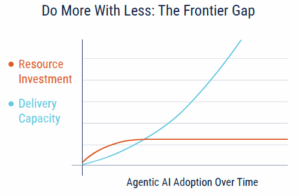
Agentic outsourcing grows delivery capacity exponentially while resource investments are more static allowing the same team to multiply addressable scope.
Outsourcing cost is traditionally based on the number, skillset, and experience level of people required to carry out a focused project or to manage an ongoing workstream. Suppliers sometimes attempt to abstract the amount of labor required by creating value-based pricing according to the work’s returns. In novel or high-risk situations, purchasers sometimes agree to engage with suppliers who make value-based proposals.
When suppliers commit to using AI agents to expand delivery capacity with proper security and governance controls, they tacitly agree to diverge from conventional service-business growth models. Frontier outsourcing promises better returns than offshoring. However, suppliers who see new value and purchasers who see reduced labor and subsequent cost savings might spar in negotiations to defend the opportunity for their respective businesses.
The new value equation includes:
- Capacity gains from AI-assisted productivity
- Risk reduction from security expertise and governance frameworks
- Quality improvements from continuous monitoring and evaluation
- Knowledge transfer from suppliers experienced in agent deployment
- Faster time-to-value from pre-built infrastructure and proven patterns
Suppliers will follow the opportunity as a matter of survival. Those who don’t evolve will exit the supplier ecosystem willingly or through business failure. A sustainable business approach and a new opportunity to create a virtuous cycle occur when suppliers agree to pursue maximum capacity gains with uncompromising security standards, and purchasers agree to award maximum scope to utilize these optimized teams.
A Playbook for Purchasers: Maximizing Value from AI-Driven Outsourcing
Key Takeaways
- Anchor outsourcing strategy in a clear vision aligned with AI goals for agility, cost control, and scale.
- Choose frontier-ready suppliers already leveraging AI agents and retraining teams.
- Pilot, learn, and scale deliberately from targeted projects to enterprise-wide adoption.
It will take time to realize the promised gains of frontier outsourcing. Even the most sophisticated suppliers cannot escape the simple truth that agentic AI is a new and evolving technology. The agentic frameworks that work with modern large language models (LLMs) are months, not years, old.
Nevertheless, suppliers can be an inexpensive and low-risk source of expertise when they demonstrate mature security and governance capabilities. Besides providing operational outsourcing, suppliers can help with strategic tasks like platform selection, technical architecture design, implementation, security hardening, and training and skill acquisition for internal teams.
Define Clear Vision and Non-Negotiable Requirements
Suppliers’ efforts will benefit from a clear vision that is revisited often and revised according to learning and insight from all sources. If a purchaser’s business is progressive and receptive to new initiatives, the business can help chart the course for its suppliers. Setting clear expectations around both capabilities and controls, such as security requirements, governance frameworks, workforce strategy—ensures all AI agent-management teams and stakeholders work toward the same goals.
Minimum viable security (MVS) requirements should be defined before vendor evaluation. We recommend controls like the following:
- Cryptographically signed audit trails
- Prompt injection testing results
- Circuit breakers for high-risk operations
- Penetration test reports with defined look-back period (last 6 months)
- Incident response procedures with prompt SLAs (<4 hours)
- Clear accountability and kill-switch authority
Assess Internal Readiness Before Vendor Selection
Before engaging suppliers, conduct honest assessments across six critical capabilities using questions like these:
- Data governance: Is data cataloged, quality-controlled, and access-governed with
freshness monitoring? - Process maturity: Are workflows documented with baseline metrics for comparison?
- Technical infrastructure: Can you monitor, log, and respond to agent behavior 24/7?
- Security operations: Do you have incident response capabilities for continuous threats?
- Legal/Compliance: Have you inventoried applicable regulations and mapped requirements?
- Change management: Are stakeholders engaged, trained, and prepared for adoption?
Projects will fail regardless of vendor quality if critical gaps are not addressed before vendor selection. Savvy vendors will ask if assessments like these have been completed before mobilization, preferably in the evaluation process. Failures due to these gaps can result in a “blame game” and create a costly cycle of losses for purchasers
Select Supplier Partners Based on Demonstrated Maturity
Prioritize suppliers who demonstrate agentic maturity and security capabilities. These suppliers are already experimenting with or deploying AI agents with proper controls. Look for evidence of:
- Retrained teams operating as agent managers
- Established agent frameworks with security hardening
- Evaluation infrastructure and monitoring dashboards
- Documented governance procedures and incident response
- Successful pilot deployments with measurable outcomes
- Clear workforce transition strategy for their own teams
Traditional vendor selection criteria (cost, capacity, domain expertise) remain important but must be supplemented with security, governance, and transformation capabilities.
Start with Focused Pilots, Not Enterprise-Wide Deployment
Choose a manageable scope, such as a single business unit or workflow, to test frontier outsourcing. Select use cases with:
- Clear, measurable success criteria
- High value but limited catastrophic downside risk
- Sufficient complexity to demonstrate agent capabilities
- Baseline metrics for comparison
Use pilots to evaluate supplier performance, agent effectiveness, security controls, and internal readiness for broader adoption. Deploy in stages: 5-10% of users for 2 weeks, then 25% for 4 weeks, before full deployment. This limits the blast radius when bugs are most likely
Plan for Scale with Continuous Improvement
As pilots succeed, develop a roadmap for expanding frontier outsourcing across functions and geographies. Consolidate workstreams with high-performing suppliers to maximize efficiency
and learning. Establish regular review cadences:
- Weekly during development
- Daily during initial deployment until stable
- Monthly in operations with quarterly deep-dives
- Continuous monitoring with automated alerting
Workloads should be evaluated continually based on complexity, required human involvement, automation potential, and security risk. Make and revise long-term plans for aggregating similar work. Outsourcing becomes concentrated into a select group of suppliers who exhibit the best frontier outsourcing execution ability with proven security and governance capabilities.
How Suppliers Must Evolve to Thrive in the Frontier Era
Key Takeaways
- Reskilling is essential; supplier teams must be trained as AI agent managers.
- Suppliers that experiment methodically with AI build credibility and become strategic partners.
- Agent use drives more automation; frontier suppliers thrive while laggards fall behind.
Frontier outsourcing is a survival strategy for supplier firms, and readiness through retraining, reskilling, and security investment is crucial. People will always be required, but the way in which they are leveraged is changing radically. Regardless of role or function, AI agents are an irresistible form of cheap, on-demand digital labor that businesses will use to get ahead. Suppliers that embrace the vision for agentic AI with uncompromising security standards and that bravely and proactively turn to the frontier will outperform peers who remain focused on human-scale and billable hours.
A Successful Frontier Supplier:
Builds security and governance as core competencies
- Implements cryptographically signed audit trails, prompt injection defenses, and circuit breakers as standard practice
- Conducts regular red team testing and security assessments
- Establishes evaluation infrastructure before building agents
- Creates comprehensive monitoring dashboards tracking performance, cost, drift, and hallucinations
- Documents incident response procedures and conducts tabletop exercises
Proactively educates and retrains teams
- Builds teams focused on maximizing efficient task execution and training teams to be agent managers
- Invests in continuous training programs to keep pace with rapidly evolving technologies
- Emphasizes team flexibility to constantly adapt practices
- Creates clear career pathways for human-agent collaboration with internal certification and promotion criteria
Engages clients as transformation partners
- Talks with clients about the frontier model and security requirements
- Begins to experiment within the bounds of client policy with full transparency
- Shares learnings from security assessments, failed experiments, and successful deployments
- Helps clients navigate workforce impact with proven transition strategies
Delivers measurable value with controlled risk
- Automates routine tasks with basic AI agents while maintaining security controls
- Shares ideas for integrating more sophisticated AI agents into business applications
- Naturally delivers new value through continually increased output
- Measures and reports quantitatively on how AI integration supports business objectives while reducing risk
Scales through consolidation and excellence
- Flourishes through the consolidation of contracts into existing teams
- Grows as enterprises seek the efficiencies and risk management they create
- Becomes preferred partner for enterprises expanding AI adoption across functions
Prioritize Workflows Systematically
Evaluate and rank business workflows based on complexity and potential gains. Focus on those that offer the greatest return on investment and can significantly improve efficiency. Some processes might benefit from complete reinvention, as AI agents can help solve business problems in entirely new ways.
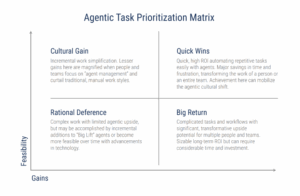
Prioritization Matrix Considerations:
- Automate now (Low complexity, high gain): Spellcheck, invoice matching, simple data entry
- Reimagine (Low complexity, very high gain): Customer triage with human fallback, contract negotiation assistance
- Supplement with AI (High complexity, high gain): Complex financial modeling, one-off bespoke strategy work
- Defer (High complexity, low gain): Low repeatability work better handled by humans
Iteration over time allows for better risk management and overall better process outcomes. Build and expand increasingly sophisticated agents as confidence and expertise grow. These agents can provide deeper insights, enhance decision-making, and drive innovation within the organization.
Getting Started: Your Roadmap to Frontier Outsourcing
Key Takeaways
- Pilot, then scale. Test frontier outsourcing in small workflows before expanding enterprise-wide.
- Build readiness. Train teams to manage and work alongside AI agents
- Align strategy. Tie outsourcing efforts directly to business and AI goals.
A successful shift to frontier outsourcing is a gradual process that requires careful planning and execution. Purchasers and suppliers should work together to set clear objectives, identify key performance indicators (KPIs), and regularly assess progress to ensure goals are being met. The following recommendations will help suppliers and purchasers begin the transformation to a frontier model.
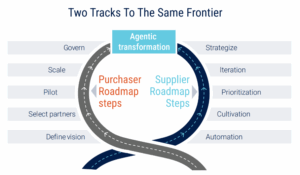
For Purchasers
Immediate (Next 30 Days):
- Inventory shadow AI usage through network monitoring and employee surveys.
- Define minimum viable security (MVS) requirements based on data sensitivity and regulatory obligations.
- Assess internal readiness across data, process, infrastructure, security, legal, and change management.
- Secure executive sponsorship and establish a cross-functional governance committee with kill-switch authority.
- Train and incubate teams with their first agents by focusing on helping people who perform repetitive tasks.
Foundation-Building (31-60 Days):
- Issue RFPs incorporating MVS requirements and outcome-based payment terms.
- Conduct technical due diligence on vendors (architecture reviews, security assessments, reference checks).
- Negotiate contracts with explicit security SLAs, liability clauses, and claw-back provisions.
- Develop joint incident response plans and conduct tabletop exercises.
- Assess workforce impact and design transparent transition plans with retraining investment.
Pilot Launch (61-90 Days):
- Deploy 2-3 pilot use cases to demonstrate value without catastrophic downside risk.
- Implement comprehensive monitoring before agents touch production systems.
- Conduct red team testing to validate security controls under adversarial conditions.
- Establish feedback loops to capture learnings and refine the approach.
- Communicate transition plans with visible leadership commitment.
Scale (90+ Days):
- Expand successful pilots using staged rollout (5% → 25% → full deployment).
- Consolidate workstreams with high-performing suppliers.
- Continuously monitor and improve with monthly reviews and quarterly deep-dives.
- Track role redesign opportunities and invest in continuous learning pathways.
- Measure success across productivity, quality, cost, security, and employee outcomes.
For Suppliers
Immediate (Next 30 Days):
- Start with automation of simple, repetitive tasks that demonstrate value and build stakeholder confidence.
- Invest in security infrastructure: unique agent identities, audit logging, circuit breakers, monitoring dashboards.
- Train and skill teams immediately with continuous programs to build, manage, and work alongside AI agents.
- Build evaluation infrastructure first before deploying agents to production.
Foundation-Building (31-60 Days):
- Prioritize workflows based on complexity and potential gains using systematic assessments.’
- Implement red team testing and document security controls.
- Establish governance procedures with clear accountability and incident response.
- Develop client engagement materials demonstrating security maturity and transformation expertise.
- Document workforce transition strategy showing successful role redesign in your own organization
Capability Expansion (61-90 Days):
- Build and expand increasingly sophisticated agents as confidence and expertise grow.
- Conduct quarterly security assessments with rotating attack vectors.
- Measure improvement quantitatively with targets for optimal human-AI balance.
- Share learnings and best practices with clients to build trust and demonstrate value.
- Create continuous learning pathways for employees with clear career progression.
Partnership Maturity (90+ Days):
- Operate as embedded AI accelerators continuously expand capacity and transfer knowledge.
- Model future of work for client organizations through successful human-agent collaboration.
- Drive consolidation by demonstrating superior security, governance, and transformation capabilities.
- Contribute to industry standards and share knowledge to elevate the entire ecosystem.
Shaping the Future of Outsourcing with AI Agents
Key Takeaways
- Outsourcing is evolving from labor arbitrage to AI-powered transformation.
- Frontier outsourcing redefines business, making suppliers embedded AI accelerators.
- The frontier is a mindset; adopters set the standards for tomorrow’s intelligent enterprise.
Agentic AI is reshaping the outsourcing landscape and turning traditional service models into dynamic, agent-powered ecosystems. Frontier outsourcing can help organizations unlock unprecedented gains in efficiency, agility, and enterprise transformation by anchoring in agentic AI and strategic supplier partnerships. It also enables reimagined business applications decoupled from human-centricity, along with uncompromising attention to security, governance, and workforce dignity.
The frontier is a mindset, not a destination. Businesses that commit to this new way of working—with simultaneous investment in technology, security, governance, and people—will not only outperform their peers, but will also shape the standards, platforms, and practices that define the next era of the intelligent enterprise.
The technology works. The benefits are real. The risks are severe. Success belongs to organizations that recognize agentic AI as a fundamental shift requiring new approaches to security, governance, operations, and workforce management—and to suppliers who partner with them to navigate this transformation with expertise, discipline, and humanity.
Prowess Consulting has successfully embraced agentic AI through delivery in high-scale outsourced enterprise programs and through focused train-build sprints that help clients start their journey into the frontier. To learn more or to schedule a consultation, email us at info@prowessconsulting.com.
Ready to Explore What Agentic AI Can Do For Your Organization?
The technology is ready and increasingly capable. If you are ready to explore what’s possible, let us show you, in your current business context, how fast and easy it is to make significant productivity gains.
If you haven’t already, we invite you to schedule time with a Prowess Consulting AI expert. This isn’t a high-pressure sales conversation. No pressure is required because we genuinely believe the gains will speak for themselves through swift, significant ROI. So let’s identify where you’re bogged down and show you how quickly we can create your first agent together.
For detailed implementation guidance on vendor selection, technical controls, shadow AI management, adversarial threats, and organizational readiness, contact Prowess Consulting.
____________________________________________________________________________________________________________________
Want to learn more about agentic AI?
- Learn more about our agentic AI offering.
- Book your free AI assessment today!
____________________________________________________________________________________________________________________
1 Gartner. “Gartner Predicts Over 40% of Agentic AI Projects Will Be Canceled by End of 2027.” June 2025.
2 IBM. “Cost of a Data Breach Report 2025.” 2025.
3 Microsoft. “Becoming a Frontier Firm: Our IT playbook for the AI era.” December 2025.
4 LayerX. “Enterprise AI and SaaS Data Security Report 2025.” 2025.
5 Knostic. “The 20 Biggest AI Governance Statistics and Trends of 2025.” November 2025.
____________________________________________________________________________________________________________________
The analysis in this document was done by Prowess Consulting.
Prowess Consulting and the Prowess logo are trademarks of Prowess Consulting, LLC.
Copyright © 2025 Prowess Consulting, LLC. All rights reserved.
Other trademarks are the property of their respective owners.
For more information, visit our website: www.prowessconsulting.com
Contact: info@prowessconsulting.com | 206.443.1117